

If you own a home in New Hampshire, your roof takes a beating that homeowners in milder climates simply do not deal with. We are talking about 60 to 100 inches of snowfall per year in northern NH, ice dams that quietly tear apart shingles and flashing over the winter, and spring thaw cycles that stress every seam and nail hole in your roof system.
So how long does a roof last in New Hampshire? The honest answer: shorter than the national averages most roofing manufacturers advertise. An asphalt shingle roof rated for 30 years in Georgia might give you 20 to 25 years here — if it was installed correctly and maintained.
This guide covers every common roofing material, what actually shortens roof life in NH, and the specific signs that tell you it is time to start calling contractors — before a small problem becomes a $40,000 structural repair.
How Long Do Roofs Last in Cold Climates Like New Hampshire?
The national average for an asphalt shingle roof is often quoted at 20 to 30 years. In New Hampshire, that range shifts to 15 to 25 years for standard 3-tab shingles and 20 to 30 years for architectural (dimensional) shingles — depending heavily on installation quality, ventilation, and maintenance.
New Hampshire sits in USDA Hardiness Zones 4 through 6, with northern regions routinely seeing temperatures drop to -20 F or colder in January. Here is why that matters for your roof:
- Freeze-thaw cycles crack and lift shingles. Water gets under the edge, freezes overnight, expands, and works the shingle loose. Over a decade this happens hundreds of times.
- Ice dams form when heat escapes through a poorly insulated attic, melts the base of snow on the roof, and the meltwater refreezes at the cold eaves. This backs water up under shingles and into your home.
- Heavy snow loads — 40 to 60 pounds per square foot in some regions — stress the roof deck and fasteners in ways that simply do not happen in the South.
- UV exposure in summer is real in NH too. High-altitude UV combined with heat cycling accelerates shingle granule loss.
Our team at Nick Tracy Roofing has inspected thousands of NH roofs across the Seacoast region. Read what our customers say about our work on our customer testimonials page.
Bottom line: NH homeowners should start budgeting for roof replacement at year 15 for asphalt shingles, not year 25. Waiting until visible failure means water has already entered the system.
How Long Does Each Roofing Material Last in New Hampshire?
Material choice is the single biggest factor in how long your roof lasts here. Here is the complete breakdown for NH conditions specifically:
| Roofing Material | Avg. Lifespan (NH) | Best For | Approx. Cost/sq ft |
| Asphalt shingles (3-tab) | 15–20 years | Budget-conscious homeowners | $3–$5 |
| Architectural asphalt | 25–30 years | Most NH homes | $4–$7 |
| Metal (standing seam) | 40–70 years | Heavy snow regions | $10–$16 |
| Cedar shake / wood | 20–25 years (with upkeep) | Historic/rustic homes | $7–$12 |
| Slate (natural) | 75–100+ years | Long-term investment | $20–$40 |
| EPDM / flat membrane | 20–30 years | Low-slope/flat roofs | $5–$9 |
How Long Does an Asphalt Shingle Roof Last in New Hampshire?
Asphalt shingles are on roughly 80% of homes in New Hampshire, and for good reason — they are affordable, widely available, and familiar to every contractor in the state.
Standard 3-tab asphalt shingles typically last 15 to 20 years in NH. Architectural (dimensional) shingles, which are thicker and more resistant to wind and impact, last 20 to 30 years under typical NH conditions. Premium impact-resistant asphalt shingles — worth the upgrade in NH — can reach 30 to 35 years and may reduce your homeowner’s insurance premium.
Key NH-specific tip: Always ask your contractor about ice-and-water shield underlayment. In New Hampshire, this waterproof membrane should extend at least 24 inches past the interior wall line of your home. This is what stops ice dam damage cold.
Nick Tracy Roofing installs architectural and impact-resistant asphalt shingle roofing in NH across the Seacoast region — see our full asphalt shingle options and materials.
How Long Does a Metal Roof Last in New Hampshire?
Metal roofing is one of the best long-term investments you can make on a New Hampshire home. Standing seam metal roofs routinely last 40 to 70 years in our climate, with some galvanized steel and copper systems exceeding that.
Metal handles NH weather better than any other common material. Snow slides off rather than sitting and forming ice dams. The panels expand and contract with temperature swings without cracking. And quality metal roofs carry Class 4 impact ratings, the highest available, which matters during our spring hail events and nor’easters.
The upfront cost is 2 to 3 times that of asphalt — typically $10 to $16 per square foot installed — but over a 50-year period, a metal roof often costs less than replacing asphalt twice.
See our metal roofing in New Hampshire service page to compare standing seam, corrugated, and ribbed panel options available for NH homes.
What About Rubber Roofing and Flat Roofs in NH?
EPDM rubber roofing and TPO membrane systems are the standard choice for low-slope and flat roofs on NH homes, garages, and additions. When properly installed, they last 20 to 30 years even under NH’s heavy snow loads.
Drainage is critical on flat NH roofs — standing water accelerates membrane failure and can lead to structural deck damage if left unchecked over winter. Learn more about our rubber roofing NH installation and repair services.
Best Roofing Material for New Hampshire Weather
For most NH homeowners, architectural asphalt shingles are the best value. They handle our winters well when properly installed with quality underlayment, cost $4 to $7 per square foot installed, and last 25 to 30 years.
For homeowners planning to stay in their home long-term — 20 or more years — standing seam metal roofing is the top choice. It is the best match for NH’s specific challenges: snow load, ice dams, freeze-thaw, and strong winds.
Slate is exceptional and can last over 100 years in NH — there are homes in Concord and Portsmouth with original slate roofs from the 1890s still in service. But it requires specialized installers, a reinforced roof deck, and costs $20 to $40 per square foot.
What Affects Roof Lifespan in New Hampshire?
Two identical roofs installed on the same day can differ by 10 years in lifespan depending on these factors:
Attic ventilation and insulation
This is the number one controllable factor. A poorly ventilated attic traps heat, which melts snow at the roof surface and creates ice dams. It also causes moisture buildup that rots the roof deck from below. Proper soffit-to-ridge ventilation extends shingle life by years. Every NH roof replacement should include an attic inspection.
Installation quality
A roof is only as good as its installation. In New Hampshire, this means: using the correct nail pattern for high-wind zones, installing ice-and-water shield correctly at all vulnerable points (eaves, valleys, around chimneys, skylights, and pipe flashings), and not cutting corners on starter strips and hip/ridge caps. Shoddy installation can cut your roof’s effective life in half.
Maintenance and annual inspection
Gutters packed with debris trap water at the eave line — prime ice dam territory. Overhanging tree limbs deposit debris and scrape shingles. Flashing around chimneys and skylights is the number one spot for NH roof leaks and should be inspected every spring. Catching a $200 flashing repair before winter saves a $5,000 water damage claim. Learn more about our gutter services in NH.
Roof pitch and orientation
Steeper pitches shed snow better and drain faster, extending roof life. South-facing sections see more UV and temperature cycling. North-facing sections stay wet longer and accumulate more moss and lichen, which hold moisture against shingles and accelerate deterioration. A north-facing roof section in NH may need replacement 5 years before the south-facing section on the same house.
How Often Should a Roof Be Replaced in New Hampshire?
The rule of thumb: inspect your NH roof professionally at year 10, again at year 15, and every 2 to 3 years after that if you have asphalt shingles. Do not wait for an active leak — by then, the damage extends below the shingles to the underlayment and often the deck.
Here are the concrete warning signs that mean replacement — not repair — is the right move:
- Shingles that are curling at the edges (cupping) or buckling in the middle. This means the shingles have lost elasticity and are no longer lying flat and shedding water properly.
- Significant granule loss visible in gutters or at downspout outlets. Granules protect the asphalt layer from UV. Heavy granule loss means the shingle is in its final years.
- Multiple areas of missing shingles after a single storm. One or two missing shingles can be repaired. If you are patching after every nor’easter, the roof system is failing.
- Daylight visible in the attic. If you can see light through the roof boards, water is already getting in.
- Interior water stains on ceilings, especially after heavy snow melt. Never ignore these — moisture in your ceiling means water has already breached the roof system. Our emergency roof repair in NH team responds quickly to active leaks.
- Any asphalt roof that is over 20 years old and has not been inspected recently. Age alone warrants a professional evaluation.
Hail and Storm Damage — A Special NH Concern
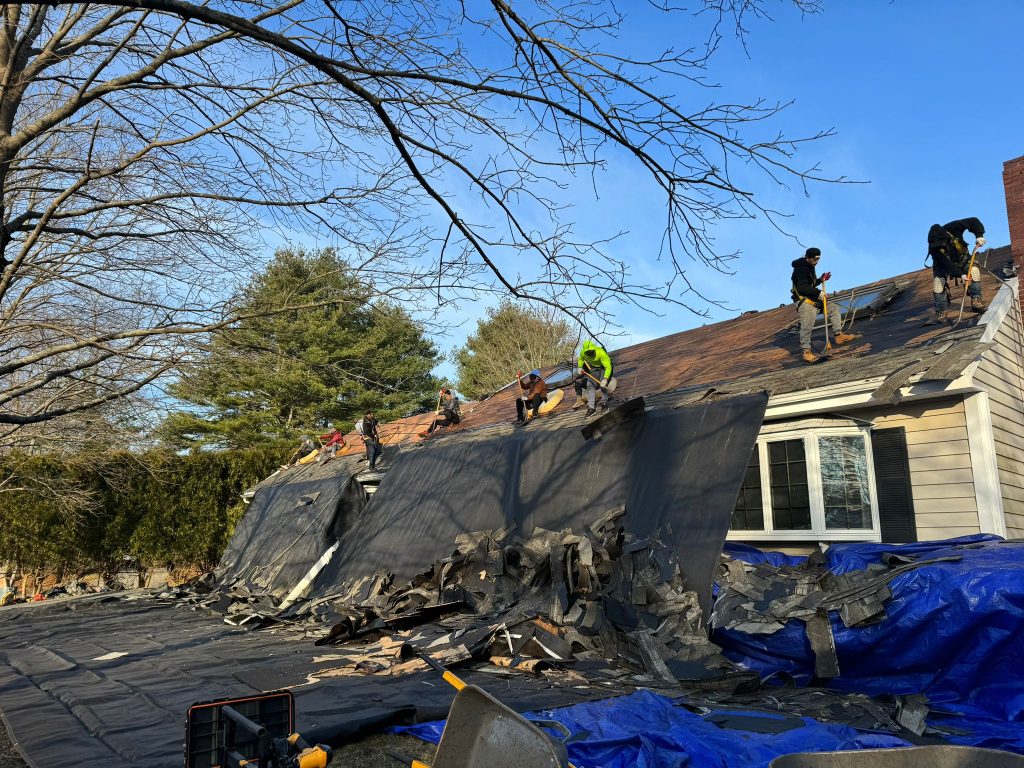
New Hampshire sees more hail than many homeowners realize, particularly in late spring and early summer. Hailstones as small as 1 inch can crack asphalt shingles, dent metal flashing, and fracture the granule surface in ways that are not always visible to the naked eye but dramatically accelerate aging.
After any significant storm, a professional inspection is worth scheduling. Our hail damage roof repair team can assess whether your roof sustained functional damage and document it for insurance purposes — most NH homeowner policies cover sudden storm damage.
When Should You Replace Your Roof in New Hampshire?
Timing a roof replacement in New Hampshire matters more than in warmer states. Asphalt shingles need temperatures above 40 F to seal properly — the self-sealing strips on the shingle tabs require heat activation to bond to the shingle below.
The best windows for NH roof replacement:
- Late May through June — temperatures are consistently above 40 F, contractor schedules are opening up, and you are not rushing before winter.
- September through mid-October — the ideal NH roofing season. Cool but not cold, dry, and contractors are typically available.
- Summer (July–August) works fine and is often when you can get the fastest scheduling.
What to avoid: replacing a roof during a NH winter if at all possible. Some experienced local contractors do complete winter replacements in NH, but asphalt shingles will not self-seal until temperatures warm up.
Roof Replacement Cost in New Hampshire
Most New Hampshire homeowners spend between $8,000 and $20,000 for a full roof replacement on a typical 1,500 to 2,500 square foot colonial or cape. Here is what drives the cost:
- Material choice — asphalt shingles are the least expensive, slate and metal the most.
- Roof complexity — valleys, hips, dormers, chimneys, skylights, and steep pitches all add labor cost.
- Deck condition — if the plywood or OSB deck is rotted (common in older NH homes with inadequate ventilation), expect $1 to $3 per square foot in deck replacement costs added to your quote.
- Number of layers — NH building code allows a maximum of two shingle layers. If your roof already has two, tear-off is required, which adds $1 to $2 per square foot.
- Location — labor rates in the Seacoast region (Portsmouth, Hampton) and Manchester metro tend to run higher than in the North Country.
Pro tip: Get three written quotes. Ask each contractor specifically about what is included for ice-and-water shield, ventilation assessment, and deck inspection. The cheapest quote is not always the best value — a $1,000 savings that results in poor ventilation can cost you 5 years of shingle life.
Frequently Asked Questions About Roof Lifespan in New Hampshire
| Question | Quick Answer |
| How long does a roof last in New Hampshire? | 15–30 years for asphalt (most common). Metal roofs can last 50–70 years. Slate can exceed 100 years. |
| How much does roof replacement cost in NH? | Most NH homeowners spend $8,000–$20,000 depending on size, pitch, and material chosen. |
| What is the best roofing material for New Hampshire weather? | Architectural asphalt shingles offer the best value. Metal roofing is the top choice for longevity and snow performance. |
| How do I know if my NH roof needs replacing? | Look for: missing or curled shingles, granules in gutters, interior water stains, sagging deck, or any roof over 20 years old. |
| Can you replace a roof in winter in New Hampshire? | Yes, experienced NH roofers do it, though spring and fall are preferred. Avoid replacing during ice storms or heavy snowfall. |
Can moss and lichen damage my roof faster in New Hampshire?
Yes. NH’s humid springs and shaded north-facing slopes are ideal conditions for moss and lichen growth. Both hold moisture against shingles, accelerating granule loss and shingle cracking. If you see green or black organic growth on your roof, have it treated with a zinc sulfate or copper sulfate solution — do not pressure wash, which blasts off granules and does more damage than the moss.
Does homeowner’s insurance cover roof replacement in New Hampshire?
Standard NH homeowner’s insurance covers sudden storm damage — wind-torn shingles, a tree branch through the roof, hail damage. It does not cover gradual wear or age-related deterioration. Some insurers now offer roof actual cash value (ACV) versus replacement cost value (RCV) policies — ACV pays out depreciated value, which on a 20-year-old roof might cover less than half the replacement cost. Review your policy before you need it.
Is It Time to Replace Your Roof? Start Here.
New Hampshire roofs work harder than almost anywhere in the Northeast. If your asphalt roof is approaching 20 years, if you have had recurring ice dam problems, or if you noticed granules in your gutters this spring, it is worth scheduling a professional inspection before the next winter cycle starts the clock.
Nick Tracy Roofing — formerly Seacoast Roofing & Exteriors — provides free roof inspections and written estimates with no pressure and no obligation. We serve homeowners across the NH Seacoast and beyond, including:
- Portsmouth, NH — Seacoast’s largest city and surrounding areas
- Manchester, NH — Southern NH’s largest metro
- Hampton, NH — Hampton Beach and surrounding Rockingham County
- Exeter, NH — Exeter, Stratham, Brentwood, and nearby towns
- Dover, NH — Strafford County and Seacoast corridor
- Seabrook, NH — Our home base, serving the southern NH–MA border region
Ready to find out exactly where your roof stands? Contact us today for a free NH roof inspection. We will give you an honest assessment and a clear path forward — whether that is a few repairs or a full replacement quote.
Take the first step: request a free roof inspection and a licensed NH roofing professional will be in touch within one business day.


